Elvis Presley changed what a young American man could wear in public. Long before the white jumpsuits, he arrived on television in a windowpane-checked jacket with his hair piled four inches high, and the country decided that was a problem. The looks he wore across two decades still surface in grooming campaigns, editorial shoots, and runway collections, which is why an Elvis retrospective is also a story about how menswear got comfortable with show.
8 Elvis Outfits That Capture His Style
What Elvis wore between 1956 and 1973 became raw material for how men have dressed on stage, on screen, and in public ever since. The catalog is small and it keeps getting reopened. A camp-collar shirt in 2026, a concho belt in a heritage denim campaign, a black leather jacket on a magazine cover, a shawl-collar cable-knit styled against a greased pompadour. Each of these arrives already written, and Elvis wrote them.
The Windowpane-Checked Jacket, 1956
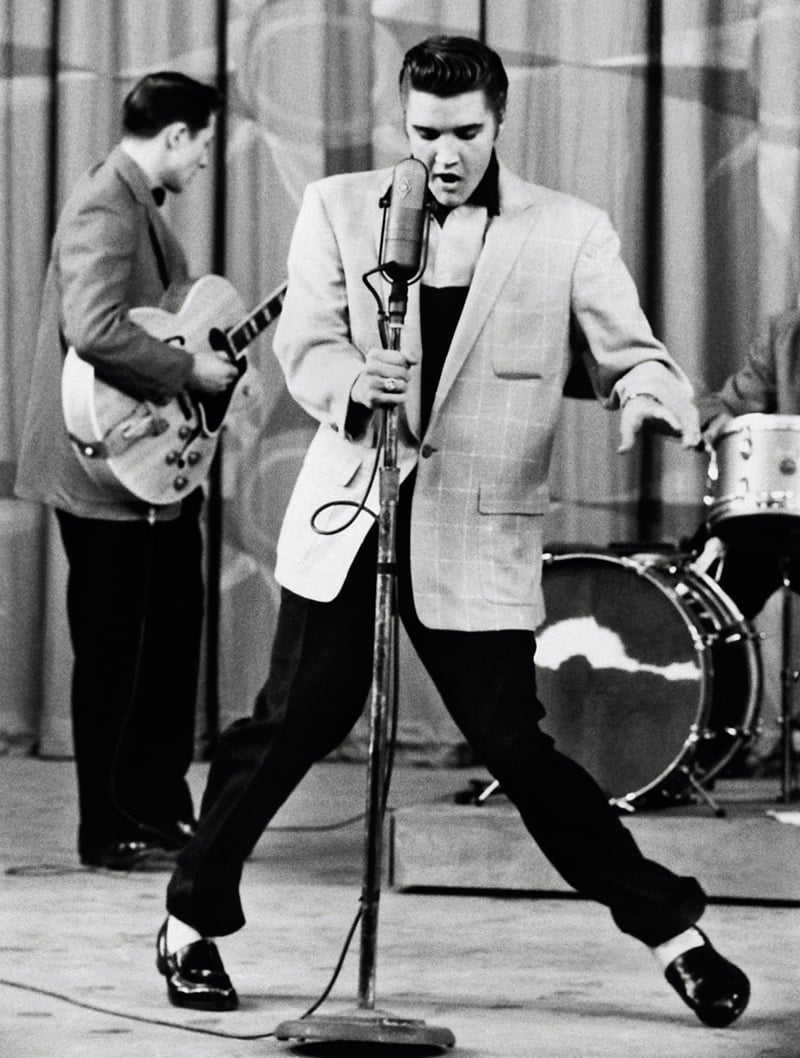
The first look is the one that scared parents. Performing in 1956, Elvis wore a pale windowpane-checked sport coat with patch pockets with dark slim trousers, and loafers with white athletic socks turned down at the ankle. The socks are the tell. They signaled teenage at a time when grown men wore dress hose, and they framed the loafer the way a painter frames a canvas.
The jacket itself was a suburban department-store cut, boxy through the shoulder and long through the body. Elvis paired it with a crouch, a guitar, and a leg kick, which turned a Sears sport coat into a pop object. Any windowpane jacket worn with dark trousers and loafers since then owes something to this stage setup, even when the wearer has no idea.
The Cable-Knit Sweater, 1956

Off the stage, the same year, Elvis sat for a photograph in a shawl-collar cable-knit pullover. The sweater is heavy gauge wool, with a plaited cable running down the chest and a ribbed shawl collar that stands up at the neck. It is the most preppy piece he ever wore on camera and the least discussed.
The pompadour was sculpted for a stage. The sweater belongs to an Ivy League weekend. Putting those two things on the same body was a newer idea in 1956 than it sounds now, and it opened the door for every subsequent rock star who wanted to look educated and every ivy-leaguer who wanted to look dangerous. Ralph Lauren made a career of that exact tension. Ralph Lauren was watching Elvis.
Jailhouse Rock Prison Stripes, 1957

The most reproduced Elvis look in pop culture comes from the title sequence of Jailhouse Rock, released in 1957. He wears a horizontally striped black-and-white prison shirt printed with the inmate number 6240, under a dark uniform jacket with white contrast stitching, over matching dark trousers and black leather dress shoes. The outfit was costume design, assembled by the MGM wardrobe department, but the cultural afterlife has belonged to him since the film opened.
The prison stripes became a shorthand for a specific strain of American outlaw charm. Every Halloween-store Elvis costume traces back to this frame. Every brand that has ever printed stripes on a T-shirt and called it rockabilly is working from the same template. The jacket’s contrast stitching is what keeps the look on the right side of cartoon. The seams give the piece a tailored logic. The shirt alone would sit closer to costume. The jacket pulls it back into clothing.
The Hawaiian Shirt in Blue Hawaii, 1961
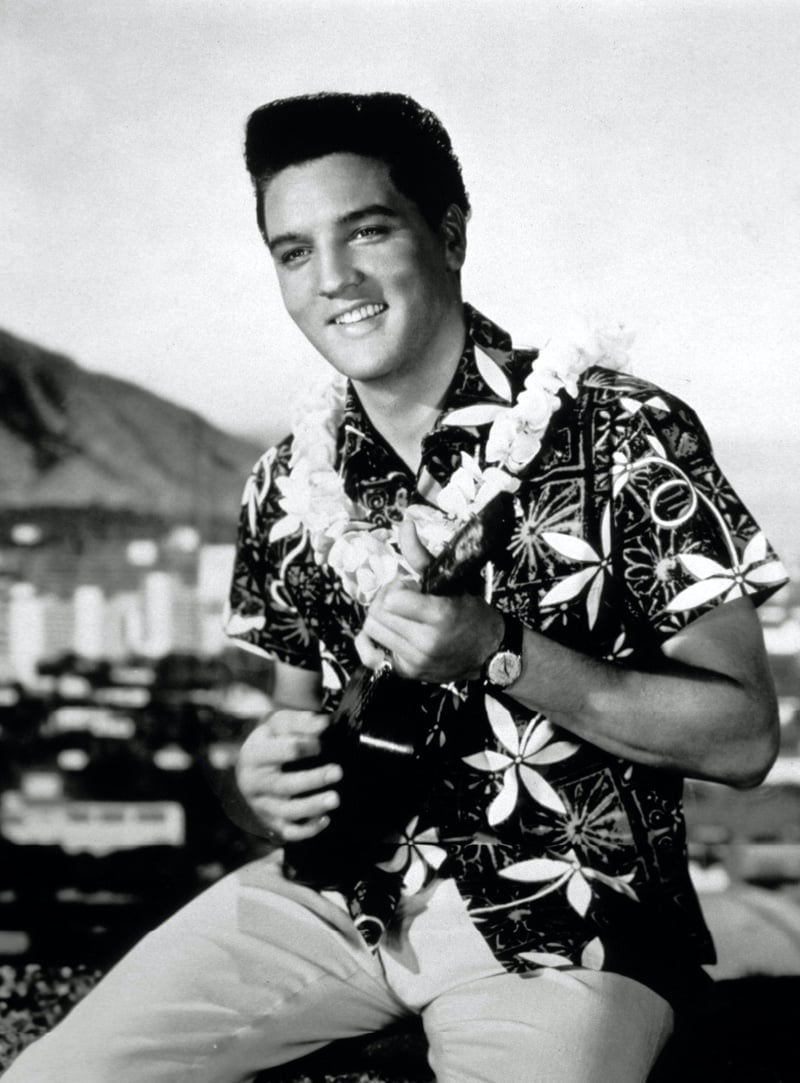
For Blue Hawaii in 1961, Elvis wore a Hawaiian shirt with a large white tropical-floral print over light cotton trousers, with a white flower lei around his neck and a ukulele in his hands. The shirt is Alfred Shaheen era Hawaiian, with heavy rayon, block-printed florals, a camp collar, and a boxy cut. It was the film that taught mainland America to associate the print with vacation and with a softer postwar masculinity.
Every Cuban-collar shirt currently sold as a summer piece is downstream of Blue Hawaii. The camp-collar silhouette has returned to menswear cycles at least four times since, and each return draws on this image regardless of whether the designer names the source.
All-Black in Girls! Girls! Girls!, 1962
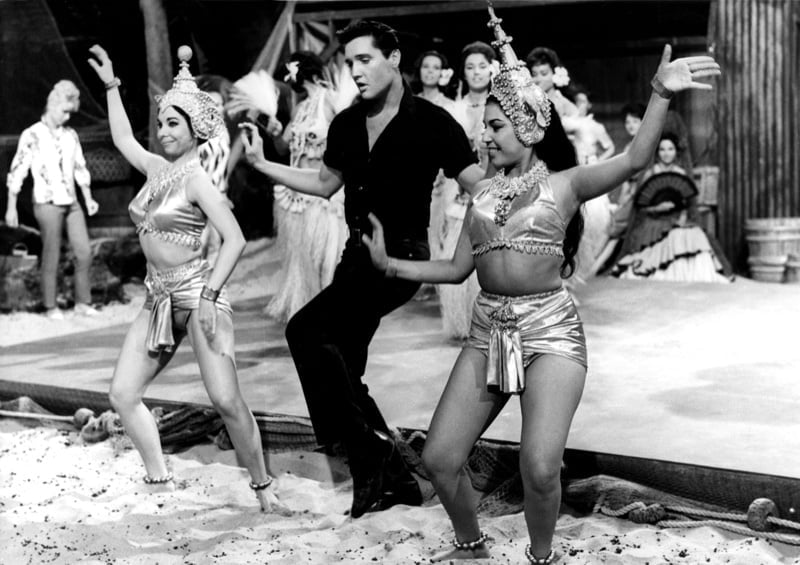
The 1962 film Girls! Girls! Girls! put Elvis in a monochrome black ensemble that lives in the margins of Elvis history and at the center of contemporary menswear. He wears a short-sleeve black camp-collar shirt tucked into flat-front black trousers, with the shirt placket open two buttons and the trousers cut straight through the leg. Behind him, two dancers in gold costumes perform a stylized Polynesian number, which sharpens the simplicity of what he has on.
This was the template for the all-black summer look that every designer from Tom Ford to A.P.C. has since sold under a different name. Black on black in short sleeves is harder than it looks. The cotton has to sit right, the trousers have to break cleanly over the shoe, and the belt has to disappear. Elvis made it work by standing still in a scene painted gold and blue around him.
The White Shirt & Silver Concho Belt in Stay Away, Joe, 1968
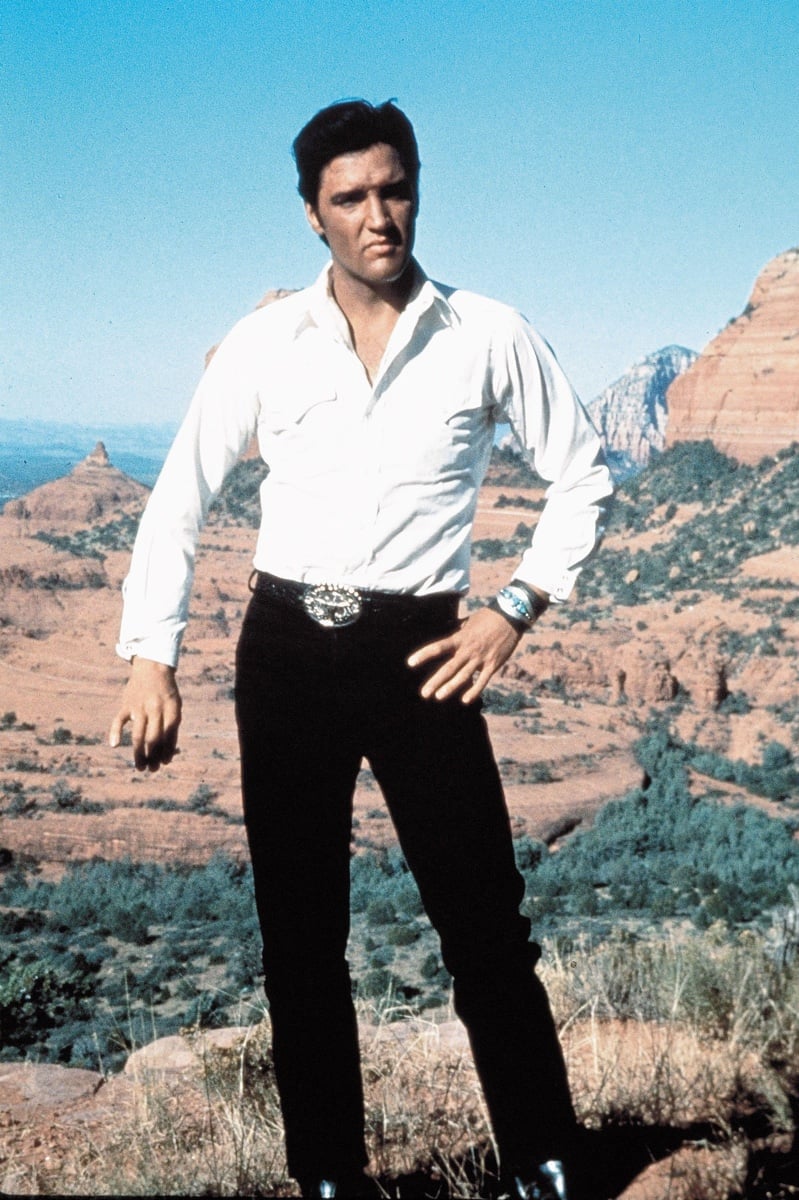
Publicity stills from the 1968 western Stay Away, Joe show Elvis standing in the Arizona red rocks in a plain white western-yoke shirt, sleeves rolled to the forearm, tucked into black straight-leg trousers. A wide leather belt sits at his waist with a large Southwestern concho buckle. On his left wrist, a Navajo-style silver cuff.
The look is the one the estate rarely markets and the one that has aged best. It has also aged most uncomfortably. Elvis was playing a half-Navajo character in a film that traded in 1968 Hollywood’s idea of Native American life, and the concho belt and silver cuff he wore were costume choices pulling from a culture the movie flattened.
The garments survived that complication because they were real to begin with. The shirt, the belt, and the cuff all appear today in current collections from Double RL, Kapital, Buck Mason, Wythe, and a dozen smaller American heritage labels. The film’s politics stayed in 1968. The silverwork went on to a longer afterlife.
The Black Leather of the 1968 Comeback Special
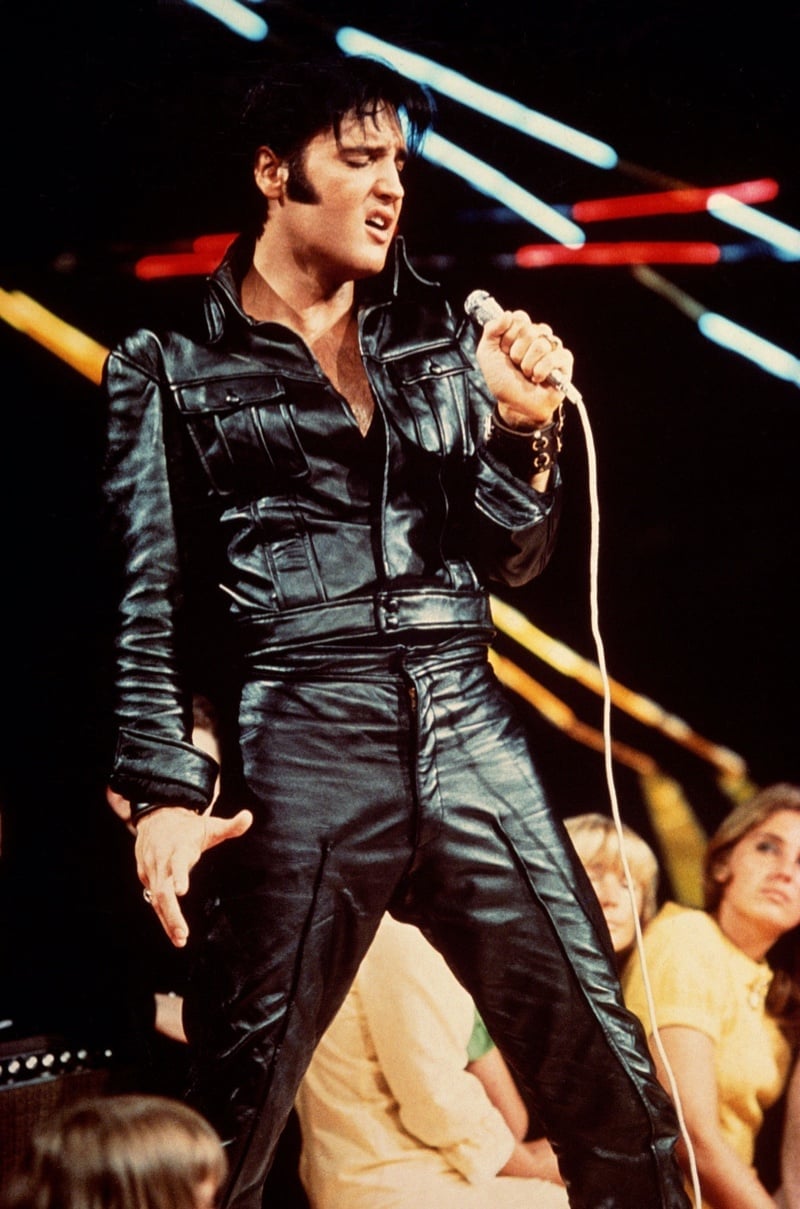
Seven years after Blue Hawaii, Elvis walked onto a small NBC stage in head-to-toe black leather and the stakes were enormous. His last live performance had been in 1961. The industry had written him off as a soundtrack singer. He came out in a fitted leather jacket, matching leather trousers, boots underneath, and opened the show.
The suit was designed by Bill Belew, who drew on the uniforms of motorcycle cops and prizefighters. The source material shows in the zippered chest detail and in the way the shoulders sit. It is the piece that rescued Elvis’s career, and it became the benchmark for every solo-star-in-head-to-toe-black-leather look that followed, from George Michael on the Faith tour to the shoot that nearly every GQ cover subject gets pushed into once a decade. The 1968 set is where that vocabulary gets its definitive version.
The White Jumpsuit, 1973
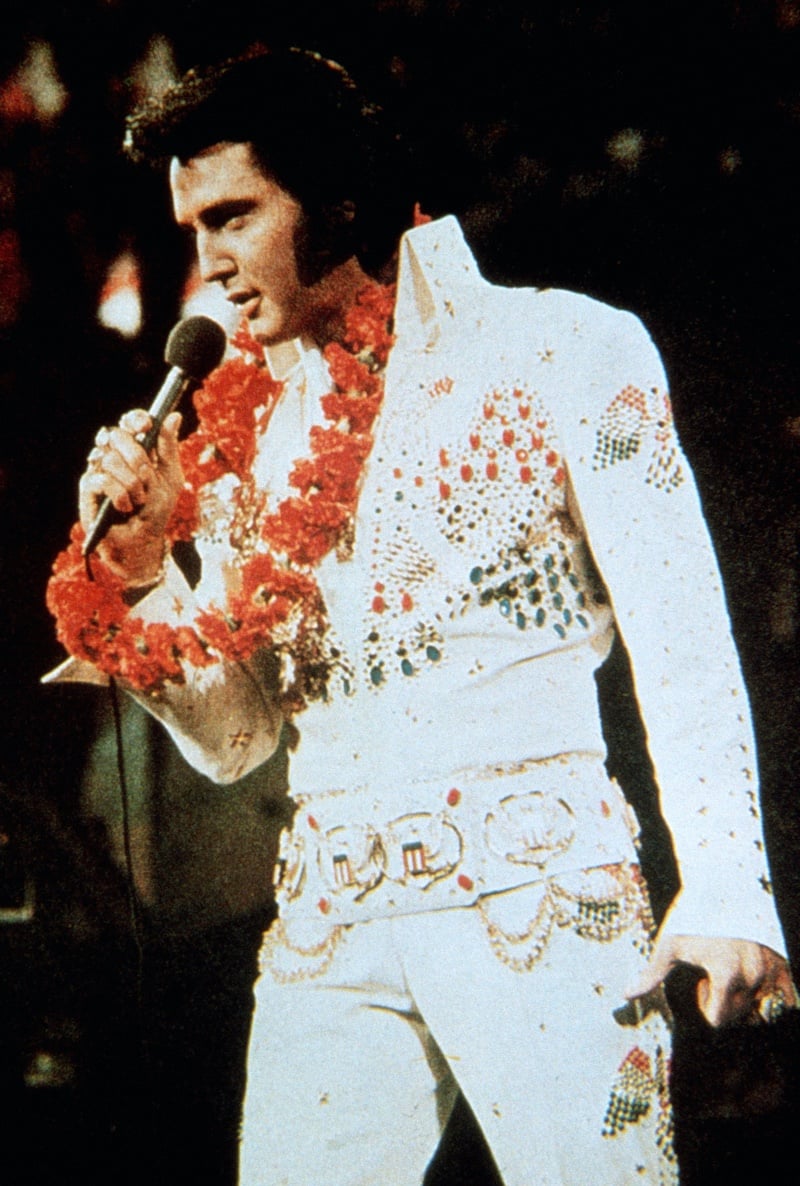
The final look is the one everyone remembers, which makes it the hardest to write about cleanly. Performing in January 1973, Elvis wore a white wool-gabardine jumpsuit embroidered with a repeating American-eagle and flower motif in red, gold, and turquoise stones, finished with a matching studded belt the width of a boxing championship. A red carnation lei hung at his neck. The whole outfit was the Aloha from Hawaii broadcast, sent by satellite to more than forty countries, and it is arguably the most-watched piece of American menswear in history.
The jumpsuit was Bill Belew again, worked in white because he wanted the camera to resolve every bead. What makes it singular is the commitment to decoration. Elvis wore embroidery the way an Elizabethan courtier wore slashed velvet, in front of an audience of one billion. Every sequined concert costume since then stands in the space this suit cleared.
When the Image Got Away From the Man
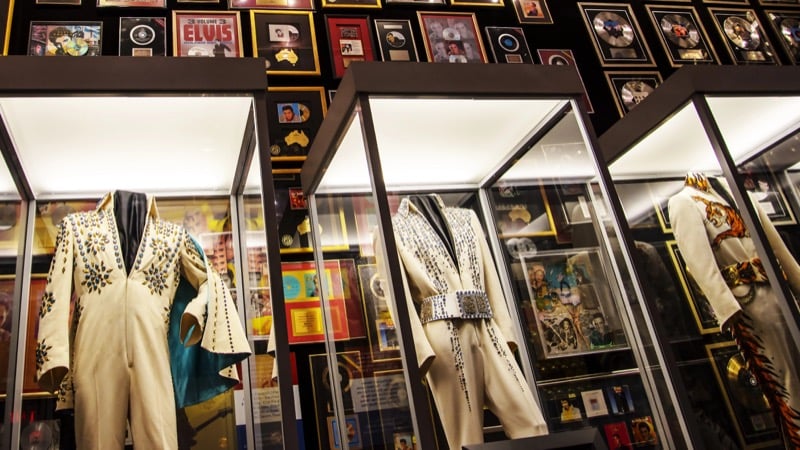
Somewhere in the mid-1970s, the jumpsuit crossed from garment into costume. Part of that was the body. Part of it was the industry around him that kept printing the same silhouette at different weights and sending it on the road.
By the time Elvis died in August 1977, the rhinestone suit had already started its second life on the backs of impersonators, and within a decade the Elvis look had become fully detachable. Any man of any build could put on the pompadour wig, the sideburns, and the white jumpsuit and get recognized instantly as Elvis, which is what happens when an image outlives its source.
The wardrobe paid the cost. The 1950s windowpane jacket, the Jailhouse Rock striped shirt, the 1968 leather suit, and the white-shirt-and-concho combination all got stuck in the costume aisle for decades. Before the American heritage menswear revival of the 2010s, they sat next to the Halloween wigs in the retail imagination. The return of these garments to real menswear has required stripping the tribute off them so the clothes work as clothes again.
Elvis’s Hair, Which Is Its Own Argument
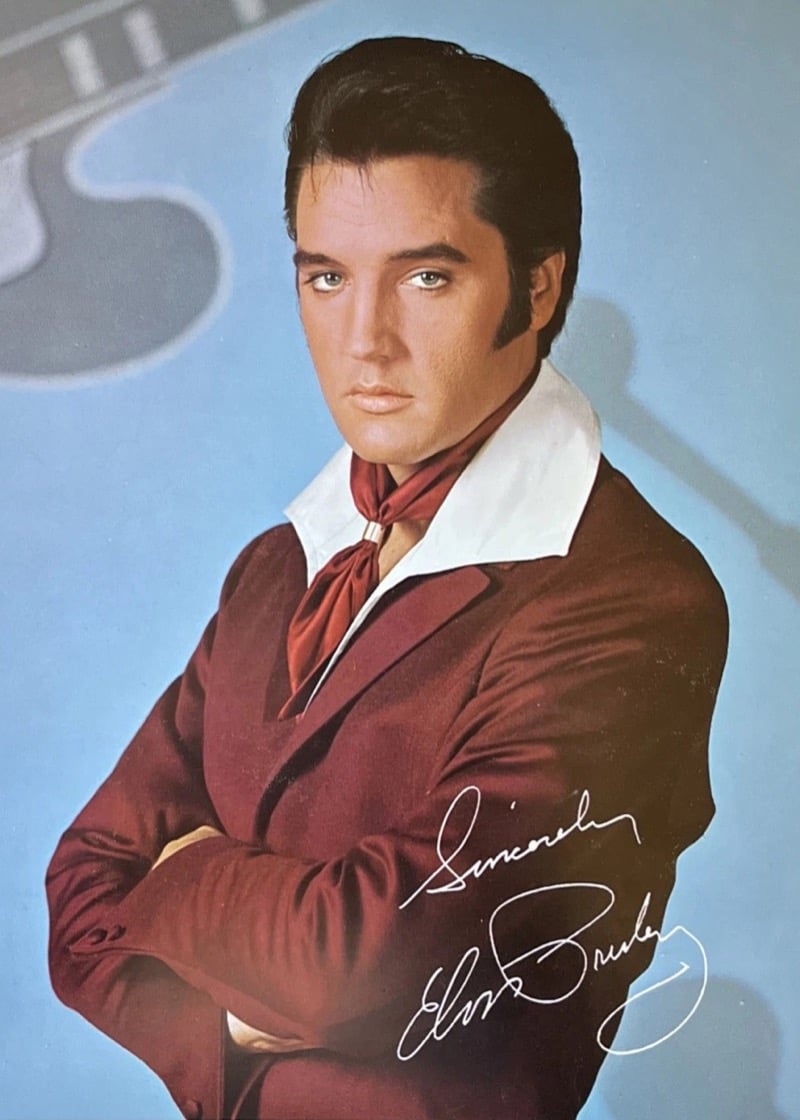
Any honest Elvis fashion piece has to stop for the hair. The pompadour, dyed jet black from its original dark blond, was the most-imitated male hairstyle of the 20th century. He wore it high, heavily pomaded, with deep sideburns that dropped to the jaw on his better days. The combination was copied by every greaser, every rockabilly revivalist, and every Japanese subculture photographed dancing in Yoyogi Park since.
The pompadour has stayed in the barbershop vocabulary for seventy years because the architecture is honest. Length on top, short on the sides, styled forward and up with product. The product itself changed over the decades, from paraffin and rose oil to Brylcreem to matte clay and sea-salt spray, and the shape held through all of it.
How to Channel Elvis Presley’s Style
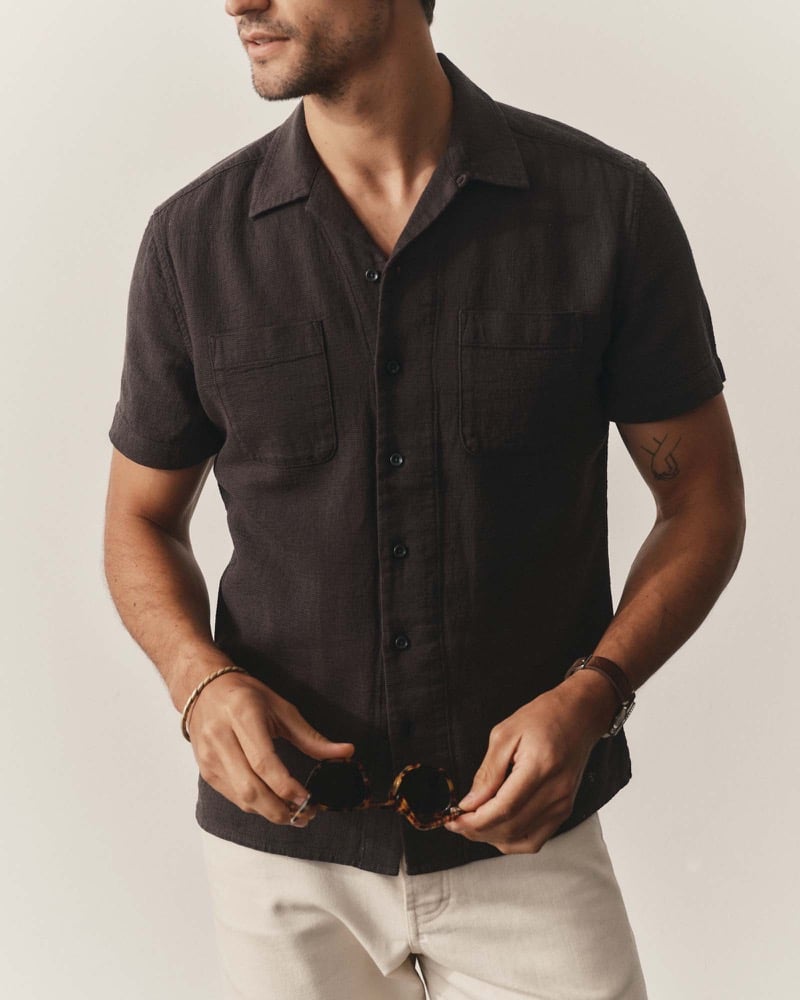
The practical pieces are already in the menswear mainstream. A western-yoke shirt, a camp-collar print shirt, a shawl-collar cable-knit, a fitted leather jacket, a flat-front trouser, and a pair of dark loafers cover six of the eight looks above. The jumpsuit stays on the stage.
What these pieces inherit from Elvis is permission to be a little too much. The cable-knit runs heavier than the body needs. The Hawaiian shirt prints brighter than a postcard. The leather jacket cuts closer to the skin than is comfortable. The concho belt sits larger than the outfit asks for.
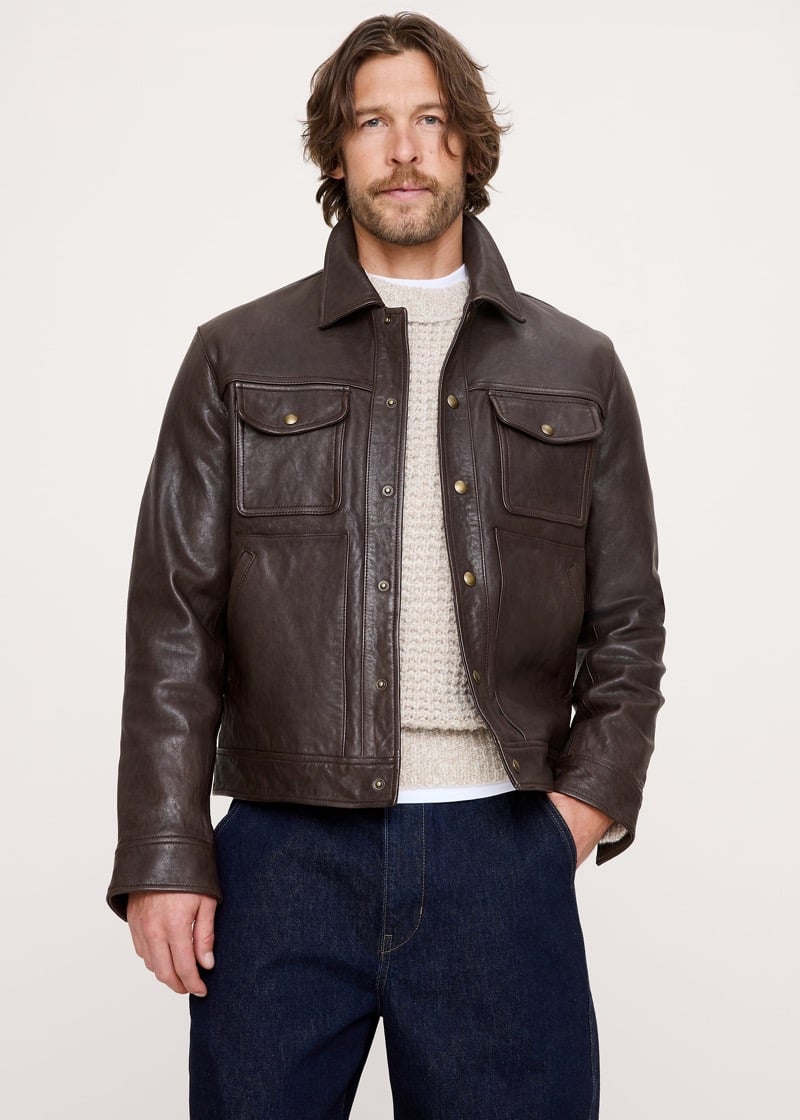
These garments survived because Elvis showed that performance and seriousness could occupy the same body, which is why Ralph Lauren sells a concho belt in 2026 and files it under American heritage. The belt still holds its original volume. The market has caught up to what Elvis already understood. The through-line is the attitude. Every one of these outfits was worn by a man who understood the camera would be on him, and who dressed for the lens before he dressed for the room.