Most men own a dozen T-shirts and reach for the same two. The rest sit folded in the drawer, retired for crimes they committed on the first wash. Collars rippled. Hems crept upward. Fabric went translucent at the chest after three cycles. The problem is rarely the T-shirt itself. The problem is that most men buy on color and price and ignore the three things that determine whether a shirt makes the rotation or fills a donation bag. Those three things are fabric, fit, and construction.
A great T-shirt sits at the intersection of those three things. Get any one wrong and the shirt stays at the back of your drawer. Get all three right and the shirt becomes the one you pull first every morning. The best men’s cotton t-shirts use mid-weight cotton around 6 oz, keep sizing consistent across production runs, and reinforce the collar with binding tape that keeps its shape through years of washing. That combination of material, proportion, and detail is what separates a T-shirt that works from one that slowly degrades in your closet. The rest of this guide breaks down each pillar so you can evaluate any T-shirt on the shelf, at any price, and know what you are getting before you spend.
Fabric: What Your T-Shirt Is Made Of

Fabric is where a T-shirt’s personality starts. Two shirts in the same color and the same size will drape, breathe, wash, and age differently based on what they are made of and how heavy the knit is. Understanding the raw material and the weight gets you further than any brand name.
Cotton Types
All cotton is not the same. The fiber length, the spinning method, and the processing all change how the finished fabric feels and how long it lasts.
Regular cotton (also called carded cotton or open-end cotton) uses short staple fibers spun quickly on an open-end machine. The yarn is slightly coarser and the fabric surface has a dry, textured hand. Most sub-$15 T-shirts use it. The shirts are serviceable, but they pill faster and lose their shape sooner because shorter fibers pull free from the yarn under friction.
Ringspun cotton runs the fibers through a ring spinning frame that twists them tighter and thinner. The result is a smoother, softer yarn with better tensile strength. A ringspun T-shirt feels noticeably finer against the skin than a carded cotton shirt at the same weight, and the tighter twist gives the fabric better resistance to surface pilling. This is the sweet spot for most men: a meaningful upgrade in hand feel and durability at a small jump in price.
Combed cotton adds a step before spinning. The raw fiber passes through fine combs that strip out short fibers and debris, leaving only the longest, most uniform strands. Combed ringspun cotton is smoother still, with a cleaner surface and better dye uptake. When a shirt at the $25 to $40 range feels noticeably soft and holds its color well after repeated washing, combed ringspun is usually the reason.
Pima and Supima cotton grow as a different plant species entirely. Extra-long staple (ELS) fibers, measuring 1.4 inches or longer, produce a fabric with a subtle luster and a silk-adjacent hand. Supima is a trademarked subset of American-grown Pima, certified for fiber length and purity. These cottons drape closer to the body and resist pilling better than any standard cotton, but they come at a premium: expect to pay $40 to $90 for a Supima tee. The tradeoff is longevity. A well-made Supima T-shirt can hold its shape and softness for years of regular wear and machine washing.
Egyptian cotton refers to long-staple cotton grown in the Nile Delta. At its best, it rivals Supima for softness and sheen. The complication is labeling: “Egyptian cotton” has historically been loosely applied, and fiber fraud investigations have found blended or misidentified cotton sold under the name. Look for third-party certification if a T-shirt claims Egyptian cotton at a suspiciously low price.
Fabric Weight: What GSM Means
GSM stands for grams per square meter, and it measures how much fabric weighs per unit area. It is the single most useful number for predicting how a T-shirt will feel and behave on the body.
Lightweight (120 to 150 GSM) T-shirts drape loosely and breathe well in heat. They work as layering pieces under jackets and overshirts. The tradeoff is transparency: many lightweight tees show skin tone or chest hair through the fabric, and thinner knits pill and hole faster at stress points.
Midweight (160 to 200 GSM) is the range where most quality T-shirts live. A 180 GSM ringspun cotton tee has enough body to hold its shape on the torso, enough weight to hang cleanly from the shoulder, and enough density to stay opaque. If you are buying one T-shirt to wear on its own, aim here.
Heavyweight (200+ GSM) produces a structured, substantial shirt that holds its form away from the body. Heavyweight tees are popular in streetwear and workwear circles, where the boxy silhouette and stiff drape are the point. A 240 GSM cotton tee feels closer to a light sweatshirt than a standard T-shirt. The fabric resists wrinkling, holds printed graphics better, and lasts longer, but breathability drops and the shirt runs warmer in summer.
Blends
Cotton-polyester blends combine cotton’s breathability with polyester’s wrinkle resistance and shape retention. A 60/40 or 50/50 blend holds its form better through repeated washing and dries faster than pure cotton. The downside is feel: polyester fibers trap body heat and can feel synthetic against the skin, and blended fabrics tend to hold odor longer than pure cotton.
Cotton-elastane (spandex) blends add 2 to 5 percent elastane for stretch recovery. The shirt conforms to the body more closely and returns to its original shape after being pulled or stretched. This small addition is common in slim-fit and athletic-fit tees. The risk is that elastane degrades in high heat, so tumble drying a cotton-elastane blend on high will slowly kill the stretch.
Tri-blends (typically 50% polyester, 25% cotton, 25% rayon) produce an ultrasoft, lightweight fabric with a heathered appearance. The rayon gives it drape, the polyester gives it durability, and the cotton keeps it breathable. Tri-blends are popular for their vintage-wash feel, though they tend to run thin and may not hold up to the same abuse as a heavier cotton tee.
For a broader look at shirt categories beyond the T-shirt, see our types of shirts guide.
Fit: How a T-Shirt Should Fit

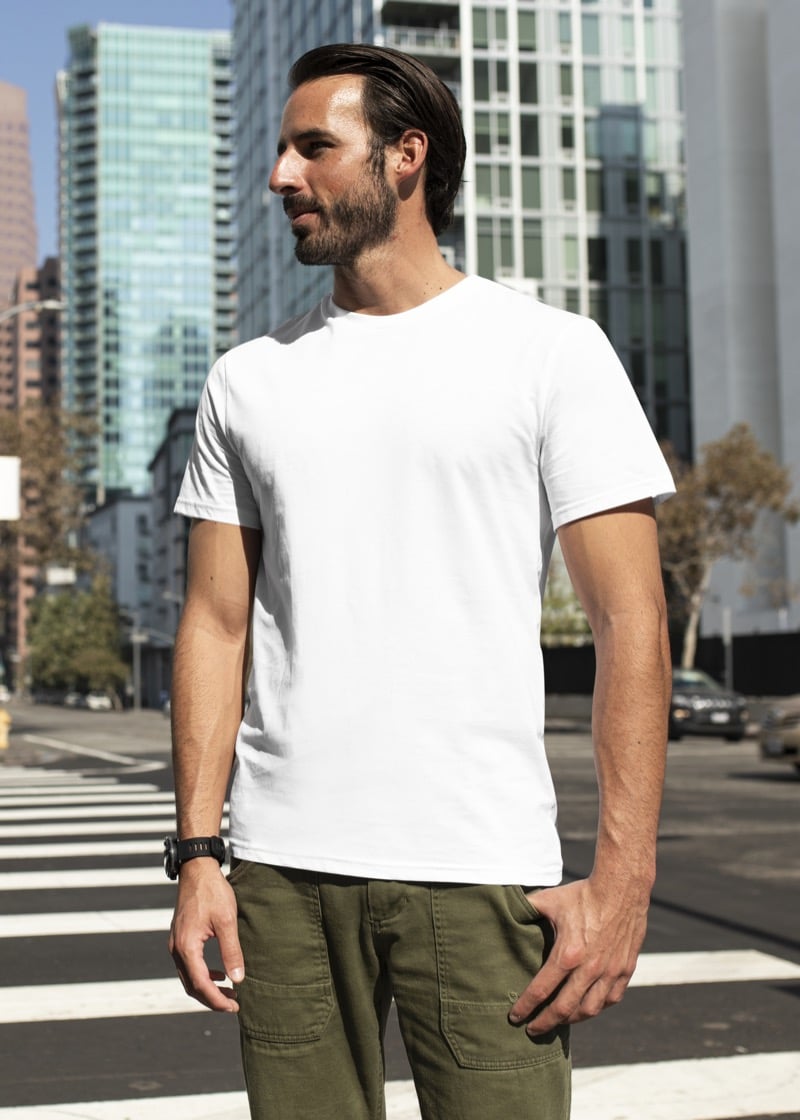
Fabric gets you the feel. Fit gets you the look. A $60 Supima T-shirt that fits poorly will look worse than a $12 ringspun cotton tee that sits right on the body. Fit is not about being tight or loose. It is about the shirt landing where it should at five specific points.
Shoulder Seams
The shoulder seam should sit at the edge of the acromion, the bony point at the top of the shoulder where the arm begins. If the seam droops past that point and hangs down the upper arm, the shirt is too wide. If it rides above the point and sits on the slope between the neck and the shoulder, the shirt is too narrow. This is the single most visible fit marker on a T-shirt, and it is the first thing to check in a fitting room.
Sleeve Length
The sleeve should end at the midpoint of the bicep, roughly halfway between the shoulder seam and the elbow crease. Sleeves that fall past the mid-bicep toward the elbow look sloppy and dated, like a shirt bought a size too large. Sleeves that stop at the upper bicep or above it shift the shirt from casual to gym wear, which may or may not be what you want.
Body Fit
Three common cuts exist, and each suits a different build.
Slim fit follows the torso closely from chest through the waist with minimal excess fabric. It works best on lean to athletic builds. The test for “too tight” is simple: if the fabric stretches visibly across the chest when you stand with arms at your sides, or if horizontal creases form across the stomach, size up or switch to regular fit.
Regular fit allows an inch or two of room through the chest and waist. The shirt follows the body’s general shape and skims the torso. This is the most universally flattering cut, and it layers better under jackets and overshirts because the additional space prevents bunching. Regular fit is the baseline.
Relaxed fit sits away from the body entirely, with dropped shoulders and a wider chest. This is a silhouette choice, common in streetwear and oversized styling. The key distinction is proportion: a relaxed-fit shirt should still look proportionate to the body. If the shirt makes the arms look disproportionately thin or the torso look shapeless, the relaxed fit has gone too far.
Length
The hem should fall around the mid-fly of your trousers when untucked, roughly 2 to 3 inches below the waistband. A simple test. If the hem covers your entire fly and approaches the thigh, the shirt is too long and will look like a nightshirt. If it rides above the belt line when you raise your arms, it is too short and will flash your stomach every time you reach for something on a high shelf.
Collar
A crew neck collar should sit flat against the base of the neck with no gaping and no constriction. You should be able to fit one finger between the collar and your neck while the fabric stays flat. The collar width matters. A wider neckline can make a narrow face look broader, while a tighter, higher crew keeps visual weight centered.
V-neck depth is a proportion game. The point of the V should fall at or above the top of the sternum. Below that and the neckline opens too aggressively for anything other than a layering piece.
Quality: How to Spot a Well-Made T-Shirt

You can check fabric content on the label and fit in the mirror. Quality is the third variable, and it requires knowing where to look.
Collar Construction
The collar is the first part of a T-shirt to fail, and the construction method determines when that failure happens. A bound collar uses a separate strip of ribbed knit stitched to the neckline, often with a tape of cotton or polyester fused to the inside of the seam. That tape prevents the collar from stretching and curling during washing. The collar keeps its shape flat against the neck for years.
A self-fabric collar folds the body fabric over and stitches it flat. This produces a cleaner look, but it is more prone to the rippled, wavy distortion that the industry calls “bacon neck.” Bacon neck happens when the collar stretches unevenly, usually from pulling the shirt on over the head. If you see a self-fabric collar on a lightweight tee with no reinforcement tape inside, expect the collar to lose its shape within 20 to 30 washes.
Seam Quality
Turn the shirt inside out. Double-needle stitching produces two parallel rows of thread at the hem, sleeve openings, and sometimes the side seams. The two rows share tension, so the seam is stronger and less likely to pucker or pull. Most quality T-shirts use double-needle hems and sleeve hems as standard.
Single-needle stitching uses one row and is typically found in budget shirts or in premium shirts where a cleaner finish is the priority (single-needle side seams produce a flatter, less bulky seam). The distinction matters most at the hem: a single-needle hem on a cheap shirt will roll and wave after a few washes.
Flatlock seams sit flush against the skin with no raised ridge. Athletic and performance tees use flatlock stitching to prevent chafing, and some premium brands use it for a cleaner interior finish.
The Transparency Test
Hold the shirt up to a light source. If you can see the outline of your hand or read text through the fabric, the shirt is too thin to wear on its own. Thin fabric pills faster, holes faster, and shows every contour of the torso underneath, including body hair and skin tone. A midweight tee (160 GSM or above) should block light almost completely.
Pre-Shrunk vs. Untreated
“Pre-shrunk” on the label means the fabric went through a controlled shrinking process (usually a compressive shrink or a hot-water rinse) before cutting. Pre-shrunk shirts should not shrink more than 2 to 3 percent in a home wash. Untreated cotton can shrink 5 to 8 percent on the first hot wash, which translates to roughly half a size. If the label does not say pre-shrunk, buy one size up or wash cold and hang dry.
The Twist Test
Grab the shirt at both side seams and twist in opposite directions. A well-made shirt in a stable knit will resist the twist and snap back to shape. A poorly made shirt in an unstable knit will distort and stay distorted, with the side seams rotating toward the front or back. That rotation is what happens over time with repeated washing, and it is why cheap T-shirts develop a twisted, off-center hang after a few months.
Price and Quality Tiers
Under $15: Carded cotton, basic single-needle hems, minimal collar reinforcement. Wearable for 6 to 12 months of regular rotation before visible degradation. Best used as gym shirts, undershirts, or shirts you expect to replace seasonally.
$20 to $40: Ringspun or combed cotton, double-needle hems, reinforced collar tape. This is where durability and comfort converge. A shirt in this range from a reliable brand should last two to three years of regular wear and washing.
$40 to $70: Pima, Supima, or high-end organic cotton. Refined finishing, cleaner seams, tighter quality control on sizing consistency. These shirts develop a softer hand with age and hold their shape through hundreds of washes.
$70 and above: Premium Japanese cotton, specialty blends, or small-batch production. The returns diminish above this point. You are paying for material rarity, production scale, or brand positioning. The shirt may be exceptional, but the gap between a $70 shirt and a $120 shirt is smaller than the gap between a $15 shirt and a $40 one.
Where to Buy: Building a T-Shirt Rotation

You do not need twenty T-shirts. Five to seven in a tight color range, bought at a quality level you can maintain, will outperform a drawer full of impulse purchases. Rotate them evenly and each shirt lasts longer because it gets less total wear.
Budget tier ($10 to $20): Uniqlo Supima Cotton Crew Neck and Kirkland Signature Pima Cotton Tee both punch well above their price point. Uniqlo’s Supima line offers extra-long staple cotton at a price that undercuts most competitors by half, with consistent sizing and a clean modern cut. Kirkland’s Pima tee is a Costco staple that delivers a heavy, opaque cotton at warehouse pricing.
Mid tier ($25 to $50): Everlane’s Organic Cotton Crew and Asket’s T-Shirt offer transparency on sourcing and pricing. Everlane uses certified organic cotton with reinforced collars and publishes the cost breakdown for every shirt. Asket works with a single Portuguese factory and offers free alterations for length, which solves the fit problem at the source.
Premium tier ($50 to $90): Lady White Co. and Sunspel occupy the upper range. Lady White produces heavyweight tees (200+ GSM) in Los Angeles from American-grown cotton with a tubular knit construction that eliminates side seams entirely. Sunspel, the English brand that has been making cotton underwear and T-shirts since 1860, uses a fine-gauge long-staple cotton that produces one of the lightest, softest tees on the market.
The principle across all three tiers is the same. Buy fewer, buy better, and replace on a schedule instead of waiting for a shirt to fall apart on your back. A rotation of five quality tees in white, black, gray, navy, and one accent color covers more ground than a shelf of twenty thin shirts in colors you grabbed on clearance. For more on building a minimalist wardrobe, that principle scales to every category in your closet.
The next time you pick up a T-shirt, turn it inside out before you check the price tag. Run your thumb across the collar seam and look for the binding tape. Hold it to the light. Pinch the fabric between two fingers and feel for the twist of ringspun yarn. Those ten seconds of inspection tell you more about what you are buying than any label, any brand name, or any marketing line ever will.