Black suits in movies have an unusually flexible job description. In Reservoir Dogs, they announce a criminal crew; in Men in Black, they come with government secrets. The same black suit can suggest authority or make a man look dangerously anonymous. Across these seven films, white shirts acquire bloodstains, ties survive improbable fights, and the clothes tell us how their wearers expect to be treated.
Reservoir Dogs Suits
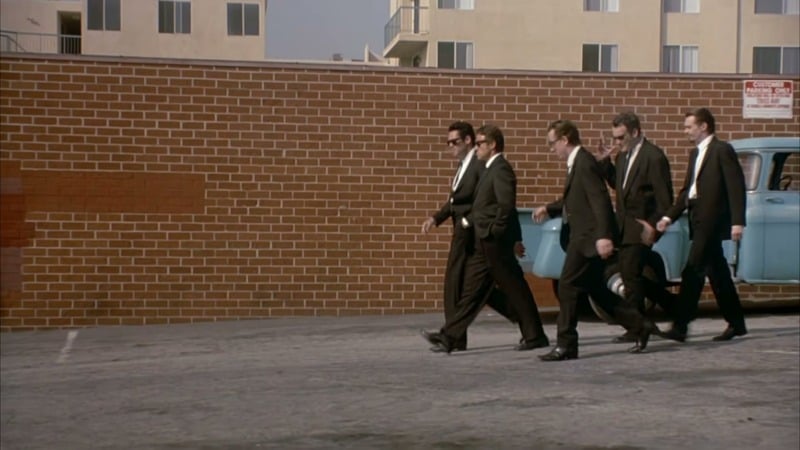
Before the robbery unravels in Quentin Tarantino’s Reservoir Dogs (1992), the men have their group image sorted. Black jackets and trousers, white shirts, and narrow black ties turn their walk down the street into an entrance. Sunglasses finish the effect. They look like a band whose next booking requires a getaway car.
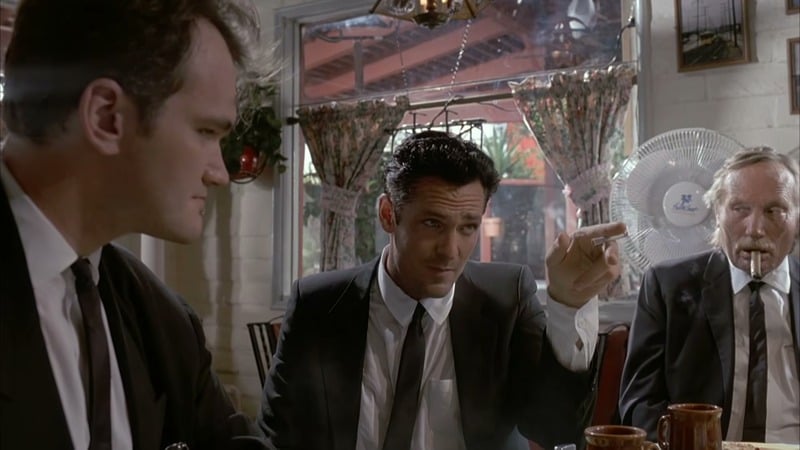
At the diner, the uniform becomes less uniform. Jackets hang differently from one man to the next, collars sit at different heights, and Michael Madsen’s long tie draws a straight line down his shirt. The shared palette gives these suspicious strangers a collective identity, while the fit leaves their individual temperaments intact.
Pulp Fiction Suit
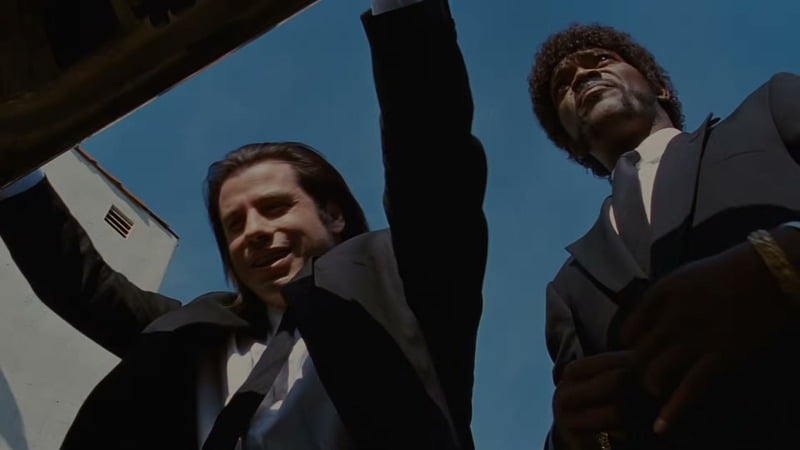
The Pulp Fiction suit became shorthand for Vincent Vega and Jules Winnfield after the film’s 1994 release. John Travolta and Samuel L. Jackson wear the black-suit-and-white-shirt combination as working hitmen who have errands to run and opinions about lunch. Their ties belong to a daily routine that happens to include collecting a briefcase at gunpoint.
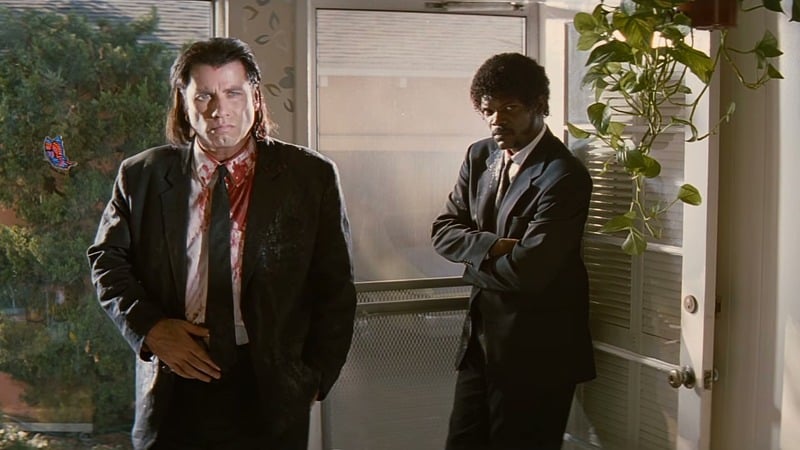
Costume designer Betsy Heimann explained the distinction between them in Dazed. Jules received a tight-fitting suit and short collar to suggest a preacher; Vincent’s rumpled linen suited his disheveled character. Seen together, they share a dress code and very different standards of upkeep. By the time Vincent’s white shirt is bloodied, the occupational hazards are difficult to miss.
Men in Black Suit

For Will Smith’s Agent J, putting on the Men in Black suit means joining an organization that erases his former identity. Tommy Lee Jones’ Agent K already wears it like a man who has completed the paperwork. In the 1997 film, their matching black ties and sunglasses suggest that alien encounters are simply another branch of public administration.
Costume designer Mary E. Vogt recalled starting with early-1960s FBI-style suits in Inverse’s oral history. That period reference gives the agents a bureaucratic credibility, even when their equipment looks borrowed from another planet. Smith’s animation and Jones’ deadpan restraint supply the personality inside the uniform.
Agent Smith’s Suit in The Matrix

Hugo Weaving’s Agent Smith brings a more oppressive type of official dress to The Matrix (1999). His tie, sunglasses, and business tailoring suggest a system with an enforcement department. Costume designer Kym Barrett confirms in her Q&A that the agents’ suits are dark green, an important distinction in a film so closely associated with black clothing.
The image of multiplied Smiths in The Matrix Revolutions (2003) pushes the uniform’s menace further. Repeated collars and tie bars make individuality seem like a clerical error. Weaving’s tightly controlled expression does the rest; even soaked through, this is a man who looks prepared to reject an application.
The Transporter Suit

Jason Statham wears Frank Martin’s black suit in The Transporter (2002) as part of a professional service. The white shirt and tie belong with the immaculate car and strict rules. He has dressed to reassure a client that the delivery will arrive exactly as agreed.
That promise becomes increasingly ambitious as the film progresses. In the photograph of Frank with a woman over his shoulder, his jacket is open and his tie has swung across his shirt, yet the outline of the chauffeur remains recognizable. The tailoring lends his physical exertion a particular absurdity. Even during a rescue, he looks as though he ought to be charging by the hour.
John Wick Suit

The John Wick suit gives Keanu Reeves a controlled silhouette from the character’s 2014 debut onward. Through the first three films, costume designer Luca Mosca used a monochromatic wardrobe to express Wick’s grief. As he explained to Film Independent, the palette includes gray and charcoal alongside black and white; lighting can make those shades appear darker on screen.
Mosca also adjusted the suits for the demands of the choreography, including protective padding and movements that put sleeves and trousers under strain. The fitted appearance conceals a practical costume operation. In John Wick: Chapter 3 – Parabellum (2019), the white collar and dark tie still frame Reeves’ face after the fighting has battered everything around them. Wick dresses with the persistence of a man who expects his evening to get worse.
Logan’s Black Suit
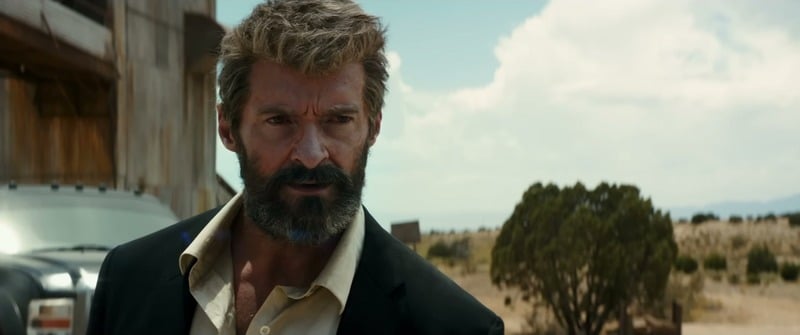
In Logan (2017), Hugh Jackman puts the black suit to a less glamorous use. Working as a limousine driver, the aging Wolverine dresses for a service job while his body struggles to keep up. The jacket and white shirt suggest the respectable exterior expected by paying passengers.
Out in the daylight, his open collar and weathered face pull against that expectation. This is tailoring after a punishing shift, worn by a man whose exhaustion shows through the dress code. After cinema’s tireless assassins and immaculate agents, Logan looks like someone who could use a day off.